
Buying Guides, Product Reviews
Carbon Fiber vs Wood Pool Cues: Which Is Better?
Mar
The carbon fiber vs wood pool cue debate is one of the hottest topics in billiards today. As carbon fiber technology becomes more affordable, players at every level face a choice: stick with traditional maple or upgrade to modern composite materials? Here is an honest, no-hype comparison to help you decide.
Carbon Fiber Pool Cues: The Modern Choice
Carbon fiber shafts are woven from thousands of thin carbon filaments, creating a rigid yet lightweight structure. The result is a shaft with ultra-low deflection — meaning the cue ball goes where you aim, even when applying heavy english.
Advantages of Carbon Fiber
- Lowest deflection — Less squirt on spin shots means more predictable cue ball control
- Zero warping — Carbon fiber does not react to humidity or temperature changes
- Consistent hit — Every shot feels the same, session after session
- Low maintenance — No need to condition, seal, or straighten the shaft
- Durability — Resists dents, dings, and chalk buildup better than wood
Disadvantages of Carbon Fiber
- Less natural feedback — Some players miss the tactile response of wood
- Higher cost — Quality carbon fiber cues start around $150-$200
- Sound difference — The hit sounds slightly different than wood (higher pitched)
- Learning curve — Players switching from wood may need 1-2 weeks to adjust
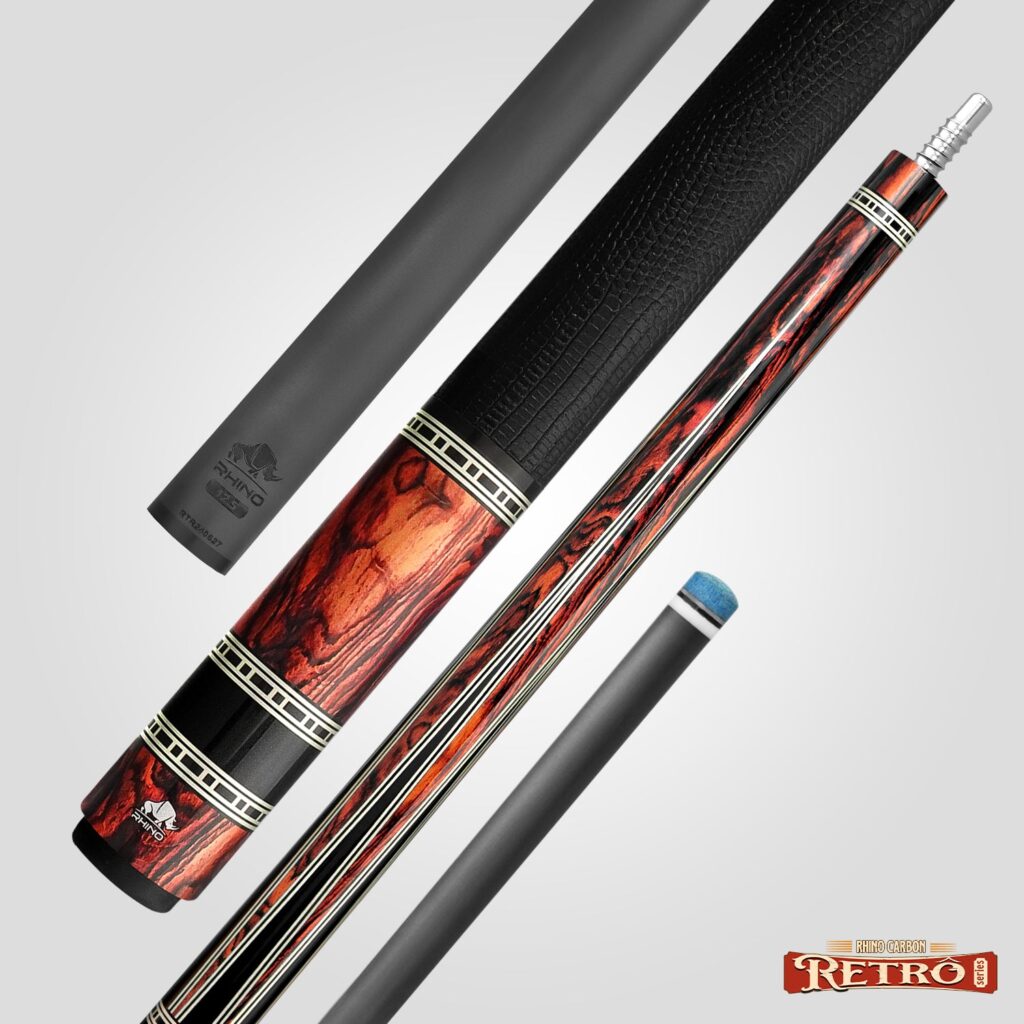
Top carbon fiber picks: Rhino RETRO series ($260-$320) and ALLIN Turtle 2024 ($150-$200).
Wood Pool Cues: The Classic Choice
Traditional wood cues — primarily North American hard rock maple — have been the standard for over a century. Premium cues also use exotic hardwoods like cocobolo, ebony, and rosewood for the butt section.
Advantages of Wood Cues
- Natural feedback — Wood transmits vibration that helps players read each shot
- Classic feel — The warmth and texture of natural wood is irreplaceable for many
- Lower entry price — Quality maple cues start around $100
- Proven performance — Generations of champions played with wood
- Aesthetic variety — Exotic woods offer stunning visual appeal
Disadvantages of Wood Cues
- Warping risk — Humidity and temperature changes can bend the shaft over time
- Higher deflection — More squirt on spin shots compared to carbon fiber
- Maintenance required — Needs regular conditioning, burnishing, and straightening
- Inconsistency — Natural grain variations mean no two shafts hit exactly alike
Best wood option: Wolf AP with W1 maple shaft ($100-$150) for beginners.
Glass Fiber: The Middle Ground
Glass fiber shafts sit between carbon fiber and maple. They offer reduced deflection compared to wood, with a feel closer to traditional maple. The Rhino G-W series ($206-$260) is an excellent glass fiber option for players who want low deflection without the full carbon fiber experience.
Head-to-Head Comparison
| Feature | Carbon Fiber | Glass Fiber | Maple Wood |
|---|---|---|---|
| Deflection | Ultra-low | Low | Standard |
| Warping | None | Minimal | Possible |
| Feedback | Moderate | Good | Excellent |
| Maintenance | Minimal | Low | Regular |
| Price Range | $150-$400+ | $200-$300 | $100-$300+ |
| Durability | Excellent | Very Good | Good |
| Sound | Higher pitch | Neutral | Classic thud |
| Best For | Competitive play | Transitioning players | Traditional feel |
Which Should You Choose?
Choose Carbon Fiber If:
- You play competitively or in leagues
- You use heavy english and spin frequently
- You want zero-maintenance equipment
- You play in varying environments (humid pool halls, dry home rooms)
- You value consistency over tradition
Choose Wood If:
- You prefer the natural feel and feedback of wood
- You are a beginner developing your stroke technique
- You play casually and prioritize enjoyment over competition
- You appreciate the craftsmanship and aesthetics of exotic woods
- Budget is a primary concern
Choose Glass Fiber If:
- You want better performance than maple but are not ready for full carbon
- You are transitioning from a traditional cue to low deflection
- You want the best of both worlds at a mid-range price
The Hybrid Option
Cannot decide? The Wolf HP Hybrid Carbon Core ($200-$250) wraps a carbon core inside purpleheart wood — giving you carbon fiber power transfer with natural wood feedback. It is an excellent compromise for players who want modern technology with traditional feel.
FAQ: Carbon Fiber vs Wood Pool Cues
Do professional players use carbon fiber cues?
Yes, increasingly. Many top professionals have switched to carbon fiber shafts (like Predator REVO) in recent years. The low deflection advantage is significant at competitive levels. Budget-friendly options like Rhino RETRO bring this technology to amateur players.
Will a carbon fiber cue make me a better player?
It will not fix fundamentals — stroke, stance, and aim still matter most. However, low deflection technology reduces one variable (squirt), making your existing skills more consistent. Most players see improvement within 2-4 weeks of switching.
How long do carbon fiber cues last?
Indefinitely with normal use. Carbon fiber does not warp, crack, or degrade like wood. The tip and ferrule may need periodic replacement, but the shaft itself is essentially permanent.
Can I put a carbon fiber shaft on my existing cue?
Usually yes, if joint types match. The most common joint is 3/8-8, used by Rhino, Lucasi, and many other brands. Check your current cue joint before purchasing a replacement shaft.
Our Recommendation
For most players in 2026, carbon fiber offers the best value for competitive play. With cues like the Rhino RETRO starting at $260, you no longer need to spend $600+ for low deflection technology. If you prefer traditional feel, the Wolf AP maple cue is an excellent choice at $100-$150.
Browse our complete selection of carbon fiber, glass fiber, and wood pool cues at HDMPool. Every cue ships worldwide with tracking.
Related Articles
Shop by Material
