
Buying Guides, Pool Tips & Techniques
Low Deflection Pool Cues Explained: What They Are and Why They Matter
Mar
You have probably heard the term low deflection thrown around at the pool hall. But what does it actually mean, and is it worth paying more for? In this guide, we explain the science behind low deflection cues and help you decide if one is right for your game.
What Is Deflection in Pool?
Deflection — also called squirt — is the sideways movement of the cue ball when you hit it off-center. Every time you apply english (side spin), the cue ball does not travel in a perfectly straight line. It squirts slightly in the opposite direction of your spin before curving back.
With a standard maple cue, this deflection can be significant — enough to miss your target by inches on longer shots. Players compensate by aiming slightly off-target, which adds complexity and inconsistency to every shot.
How Low Deflection Technology Works
Low deflection shafts reduce squirt by moving mass away from the tip end of the cue. Less mass at the tip means less force pushing the cue ball sideways during contact. This is achieved through:
- Hollow core construction — Carbon fiber and glass fiber shafts have hollow or lightweight cores near the tip
- Tapered internal design — Material is strategically removed from the front section
- Lighter tip materials — Phenolic or composite ferrules weigh less than traditional brass
The result: you can apply heavy english while the cue ball still travels close to your aim line. Less compensation means more accuracy, especially on long-distance spin shots.
Types of Low Deflection Shafts
Carbon Fiber Shafts
The gold standard for low deflection. Carbon fiber is inherently lightweight and rigid, providing the lowest possible deflection of any material. Zero warping means performance stays consistent regardless of climate or humidity.
Best options at HDMPool:
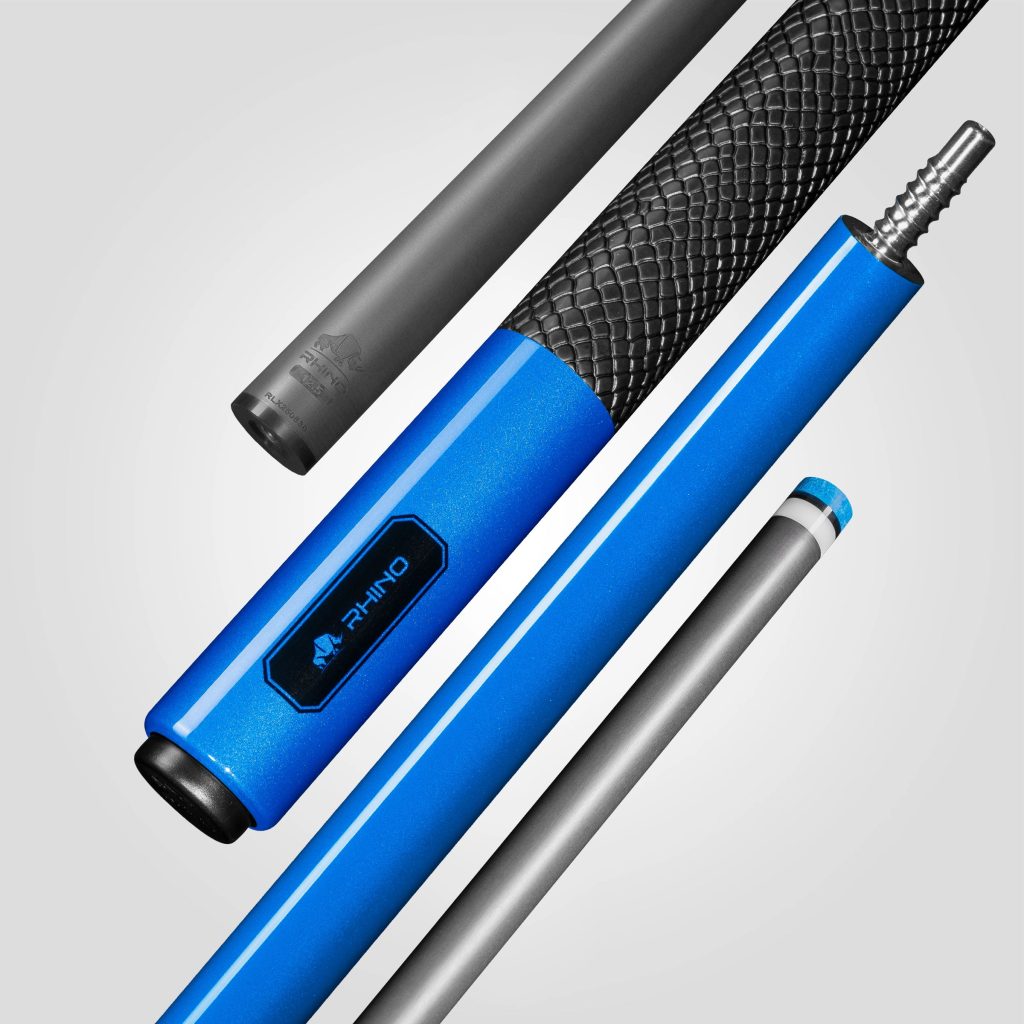
- Rhino RETRO series ($260-$320) — Carbon fiber shaft + exotic wood butt
- ALLIN Turtle 2024 ($150-$200) — Full carbon construction
- Wolf HP ($200-$250) — Hybrid carbon core wrapped in purpleheart wood
Glass Fiber Shafts
Glass fiber offers reduced deflection compared to maple while maintaining a feel closer to traditional wood. Slightly more flex than carbon fiber provides additional feedback that some players prefer.
Best option: Rhino G-W series ($206-$260) — Glass fiber shaft with Amboyna or Bocote butt
Engineered Maple Shafts
Premium brands like Predator and OB offer maple shafts with reduced deflection through internal hollowing and laminated construction. These maintain the classic wood feel while reducing squirt — but at significantly higher prices ($200-$500 for the shaft alone).
Low Deflection vs Standard: Side-by-Side
| Feature | Low Deflection | Standard Maple |
|---|---|---|
| Squirt Amount | Minimal | Significant |
| Spin Shot Accuracy | High — aim near true | Requires compensation |
| Learning Curve | Easier for spin shots | Must learn compensation |
| Feedback/Feel | Less vibration | More natural feedback |
| Warping Risk | None (CF) / Low (GF) | Moderate |
| Maintenance | Minimal | Regular conditioning |
| Price Range | $150-$400+ | $100-$300 |
Who Benefits Most from Low Deflection?
Players Who Should Upgrade
- Spin-heavy players — If you use english on most shots, low deflection is transformative
- Competitive league players — The accuracy advantage compounds over a match
- Players struggling with consistency — Removing the deflection variable simplifies your game
- Anyone tired of warped shafts — Carbon fiber eliminates this problem entirely
Players Who May Not Need It
- Pure beginners — Focus on fundamentals first. A straight maple cue is fine while learning stance, bridge, and stroke
- Center-ball hitters — If you rarely use spin, you will not notice much difference
- Players who love wood feel — Some experienced players prefer maple feedback and have mastered deflection compensation
Making the Switch: What to Expect
Switching from a standard cue to low deflection is not instant magic. Here is what typically happens:
- Week 1 — You may overshoot spin shots because you are still compensating out of habit
- Week 2 — Your brain starts trusting the cue. Shots land closer to where you aim
- Week 3-4 — The adjustment clicks. You aim more directly and your position play improves
- Month 2+ — Low deflection feels natural. Going back to a standard cue feels inaccurate
Pro tip: During the transition, practice with only your new cue. Switching between old and new cues slows the adjustment.
FAQ: Low Deflection Pool Cues
Is low deflection worth the extra cost?
For players who use english regularly, absolutely. The accuracy improvement on spin shots is measurable and immediate (after adjustment). With cues like the ALLIN Turtle starting at $150, the price gap has narrowed significantly.
Do professional players use low deflection cues?
The majority of top professionals now use low deflection shafts. Carbon fiber adoption has accelerated in recent years, with most major manufacturers offering carbon fiber options.
Can I put a low deflection shaft on my existing cue?
Yes, if the joint type matches. The most common joint is 3/8-8, used by Rhino and many other brands. Check your current cue joint specification before purchasing a replacement shaft.
What is the best affordable low deflection cue?
The ALLIN Turtle 2024 at $150-$200 offers full carbon fiber construction at the lowest price point in the market. For glass fiber, the Rhino G-W starts at $206.
Our Recommendation
If you play regularly and use any amount of english, a low deflection cue will improve your game. The Rhino RETRO series offers the best balance of carbon fiber technology, exotic wood aesthetics, and value pricing at $260-$320. For budget-conscious players, the ALLIN Turtle 2024 delivers carbon fiber performance starting at $150.
Browse all low deflection pool cues at HDMPool. Worldwide shipping on every order.
Related Articles
Shop Low Deflection Cues
